
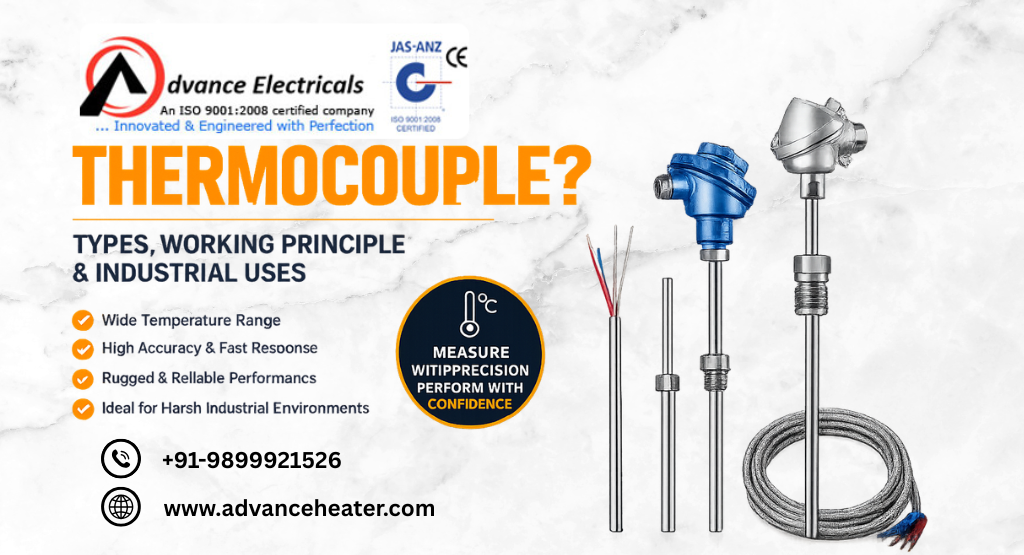
A thermocouple is a temperature sensor made by joining two different metal wires. When the junction experiences a temperature change, it generates a small voltage that corresponds to the measured temperature. Thermocouples are valued for their wide temperature range, fast response, durability, and cost-effectiveness, making them one of the most widely used temperature sensors in industrial processes.
Accurate temperature measurement is essential for maintaining quality, improving process efficiency, and ensuring operational safety across industries. Whether it's monitoring a furnace operating above 1,000°C, controlling the temperature of plastic extrusion equipment, or ensuring precise heating in food processing, selecting the right temperature sensor directly affects ion performance.
As experienced thermocouple manufacturers and thermocouple suppliers, Advance Electricals provides high-quality temperature sensing solutions for industries such as steel, plastics, pharmaceuticals, food processing, chemical manufacturing, and OEM machinery. Our thermocouples are engineered for accuracy, durability, and reliable performance in demanding industrial environments.
Among the various temperature sensors available today, the thermocouple remains the preferred choice for industrial environments because it combines simplicity, reliability, and the ability to withstand demanding operating conditions. Unlike many electronic sensors, thermocouples can measure extremely high temperatures while maintaining fast response times and dependable performance in harsh environments.
However, not every thermocouple is designed for the same application. Different thermocouple types use different metal combinations, resulting in variations in temperature range, accuracy, corrosion resistance, and industrial suitability. Understanding these differences helps engineers, OEMs, maintenance teams, and procurement professionals choose the most suitable solution for their specific process.
This guide explains everything you need to know—from the basic working principle and common thermocouple types to industrial applications, selection criteria, and practical considerations—helping you make informed decisions for reliable temperature measurement.
A thermocouple is a temperature-measuring device that converts heat into a measurable electrical voltage using two dissimilar metal conductors. Its ability to operate across an exceptionally wide temperature range, respond quickly, and withstand harsh industrial conditions makes it one of the most trusted temperature sensors for manufacturing and process industries.
Temperature is one of the most critical process variables in industrial ion. Even small temperature deviations can affect quality, energy efficiency, equipment life, and workplace safety. A thermocouple helps overcome these challenges by providing continuous temperature feedback to control systems, allowing manufacturers to maintain consistent operating conditions.
Unlike electronic sensors that rely on resistance changes or semiconductor properties, thermocouples generate their own electrical signal. This self-powered operation makes them suitable for demanding environments where durability and reliability are essential.
Because thermocouples can measure temperatures ranging from below -200°C to well above 1,700°C, they are used in industries including:
Their rugged construction, compatibility with industrial automation systems, and relatively low installation cost have made thermocouples the industry standard for temperature monitoring worldwide.
A thermocouple works by generating a small electrical voltage when two different metals joined at one end experience a temperature difference. This phenomenon, known as the Seebeck Effect, allows measuring instruments to calculate the corresponding temperature accurately.
Although the principle appears simple, it is based on a fascinating scientific phenomenon discovered nearly two centuries ago.
A thermocouple consists of two wires made from different metallic alloys joined together at one end, known as the measuring junction or hot junction. The opposite ends connect to an instrument, transmitter, PLC, or temperature controller, where they form the reference junction.
When the measuring junction is exposed to heat while the reference junction remains at a different temperature, electrons move differently through each metal because of their unique electrical properties. This movement creates a very small voltage, usually measured in millivolts.
The voltage itself is not the temperature. Instead, modern controllers compare the measured voltage with standardized thermocouple reference tables to determine the actual temperature.
The higher the temperature difference between the two junctions, the greater the generated voltage.
Modern industrial systems also use Cold Junction Compensation (CJC) to improve measurement accuracy. Since thermocouples measure temperature differences rather than absolute temperatures, controllers automatically compensate for the reference junction temperature before displaying the final reading.
This straightforward operating principle explains why thermocouples continue to outperform many alternative sensors in demanding industrial environments.
A thermocouple consists of two dissimilar metal conductors joined at a sensing junction, protected by insulation and a durable sheath. Additional components such as extension cables and connection heads ensure accurate signal transmission and long-term performance in industrial environments.
Although thermocouples appear simple from the outside, each component contributes significantly to measurement accuracy, durability, and operational reliability.
The hot junction is the sensing point where the two metals are welded together. This junction directly contacts the process temperature and generates the thermoelectric voltage.
The thermocouple wires are manufactured from carefully selected alloy combinations. Their chemical composition determines the sensor's operating range, sensitivity, corrosion resistance, and overall performance.
Electrical insulation prevents the conductors from touching each other while allowing efficient heat transfer. Depending on the application, mineral insulation such as magnesium oxide is commonly used because it provides excellent thermal conductivity and electrical isolation.
A protective sheath surrounds the assembly to protect it from moisture, chemicals, vibration, oxidation, abrasion, and mechanical damage. Stainless steel, Inconel, ceramic, and specialized alloys are selected according to process conditions.
Industrial thermocouples may also include:
Each configuration is designed to meet specific installation and environmental requirements.
The Seebeck Effect is the physical principle that enables thermocouples to measure temperature. When two different metals experience a temperature difference at their junctions, they generate a predictable electrical voltage proportional to that difference.
The effect was discovered by German physicist Thomas Johann Seebeck in 1821.
Every metal has a unique ability to move electrons when heated. When two different metals are connected and exposed to different temperatures, the imbalance in electron movement produces an electromotive force (EMF).
Although this voltage is extremely small—typically only a few millivolts—it changes consistently with temperature. This predictable relationship allows instruments to calculate accurate temperatures using internationally standardized reference tables.
Because this principle requires no external power source, thermocouples are considered self-generating sensors, making them exceptionally reliable for continuous industrial monitoring.
Thermocouples are available in several standardized types, each using different metal combinations to achieve specific temperature ranges, accuracy levels, corrosion resistance, and industrial performance. Choosing the right type depends on operating temperature, process atmosphere, response time, and application requirements.
No single thermocouple is ideal for every process. Each type is engineered to perform best under particular operating conditions.
| Thermocouple Type | Metal Combination | Temperature Range | Common Applications |
|---|---|---|---|
| Type K | Chromel – Alumel | -200°C to 1,260°C | Furnaces, plastics, food processing, heat treatment |
| Type J | Iron – Constantan | -40°C to 750°C | Industrial machinery, injection molding, manufacturing |
| Type T | Copper – Constantan | -200°C to 350°C | Laboratories, refrigeration, pharmaceutical processing |
| Type E | Chromel – Constantan | -200°C to 900°C | Cryogenic applications, precision temperature measurement |
| Type N | Nicrosil – Nisil | -200°C to 1,300°C | High-temperature industrial furnaces, power plants |
| Type R | Platinum-Rhodium | Up to 1,760°C | Glass, steel, research laboratories |
| Type S | Platinum-Rhodium | Up to 1,760°C | Calibration laboratories, aerospace, metallurgy |
| Type B | Platinum-Rhodium | Up to 1,820°C | Extreme high-temperature furnaces and kilns |
Among these options, Type K thermocouples are the most widely used because they provide an excellent balance of performance, durability, affordability, and broad temperature capability. For extremely high-temperature applications involving molten metals, ceramics, or glass ion, noble metal thermocouples such as Types R, S, and B offer superior stability despite their higher cost.
Selecting the correct thermocouple type not only improves measurement accuracy but also extends sensor life, reduces maintenance, and minimizes unplanned ion downtime.
The best thermocouple depends on your process temperature, operating environment, required accuracy, response time, and budget. While Type K suits most industrial applications, specialized environments may require Type J, T, N, R, S, or B thermocouples for optimum performance and longer service life.
Selecting the right thermocouple is about more than matching a temperature range. Engineers must also consider process conditions such as moisture, oxidation, vibration, corrosive chemicals, pressure, and mechanical stress. A thermocouple that performs well in a laboratory may fail prematurely inside a steel furnace or chemical reactor.
For general industrial heating, Type K remains the preferred choice because it offers an excellent combination of wide operating range, affordability, and resistance to oxidation. It is widely installed in ovens, furnaces, plastic processing machines, packaging equipment, and heat treatment plants.
Type J is often selected for lower-temperature manufacturing processes where fast response and cost efficiency are important. However, because its iron conductor is susceptible to oxidation, it is generally less suitable for continuously high-temperature environments.
Applications involving cryogenic temperatures or moisture-rich environments frequently benefit from Type T, while Type N provides improved long-term stability for high-temperature processes where conventional Type K sensors may experience calibration drift.
Industries such as glass manufacturing, aerospace, and metallurgy rely on Types R, S, and B because platinum-based thermocouples maintain exceptional stability at extremely high temperatures, even though they represent a higher initial investment.
Choosing the correct thermocouple reduces measurement errors, minimizes maintenance costs, and improves overall process reliability.
Thermocouples are preferred because they measure an exceptionally wide temperature range, respond quickly, withstand harsh industrial conditions, and offer reliable performance at a competitive cost. Their versatility makes them suitable for everything from food processing equipment to heavy industrial furnaces.
One of the biggest advantages of thermocouples is their ability to operate where many other temperature sensors cannot. Extreme heat, vibration, dusty environments, and corrosive atmospheres are common in manufacturing facilities, and thermocouples are specifically designed to tolerate these demanding conditions.
Their simple construction also contributes to long service life and straightforward installation. Since thermocouples generate their own electrical signal through the Seebeck Effect, they require no excitation current, reducing system complexity.
Other significant advantages include:
These advantages explain why thermocouples remain one of the most widely used temperature sensors across global manufacturing industries.
Although thermocouples are highly versatile, they are not ideal for every application. Their accuracy is generally lower than RTDs, they may experience calibration drift over time, and incorrect installation or unsuitable material selection can reduce measurement reliability.
Understanding these limitations helps buyers choose the right sensor instead of assuming every thermocouple performs equally.
Because thermocouples generate very small millivolt signals, electrical interference from nearby equipment can affect readings if proper shielding is not used. Long cable runs may also introduce measurement errors unless suitable extension or compensating cables are installed.
Continuous exposure to extremely high temperatures gradually alters the metallurgical properties of the sensing wires, leading to calibration drift. In highly corrosive environments, inappropriate sheath materials may deteriorate much faster than expected.
Compared with resistance temperature detectors (RTDs), thermocouples generally provide slightly lower measurement accuracy. However, they compensate for this by offering much higher temperature capability and greater mechanical durability.
Selecting the correct thermocouple type, protective sheath, installation method, and calibration schedule significantly minimizes these challenges.
Choosing an experienced thermocouple manufacturer in Delhi and supplier ensures consistent quality, accurate temperature measurement, application-specific customization, and dependable technical support. Working directly with the manufacturer also improves delivery timelines and long-term reliability.
Thermocouples are used wherever accurate and reliable temperature monitoring is essential. Their versatility allows them to serve industries ranging from steel manufacturing and plastics processing to pharmaceuticals, food ion, power generation, and industrial automation.
Almost every manufacturing process depends on temperature control to ensure quality, energy efficiency, and equipment safety.
In steel and foundry industries, thermocouples monitor furnaces, molten metal, reheating operations, and heat treatment processes where temperatures frequently exceed 1,000°C.
The plastic and rubber industry uses thermocouples extensively in injection molding machines, extrusion lines, blow molding systems, and hot runner applications to maintain consistent material properties.
Within the food and beverage sector, accurate temperature measurement helps achieve regulatory compliance while ensuring consistent cooking, pasteurization, sterilization, and packaging.
Chemical processing plants rely on thermocouples to monitor reactors, storage vessels, pipelines, and distillation systems where maintaining precise temperatures directly affects quality and operational safety.
Selecting the right thermocouple involves evaluating operating temperature, process atmosphere, sensor construction, response time, installation method, accuracy requirements, and equipment compatibility. A carefully selected thermocouple improves reliability while reducing maintenance and replacement costs.
Many buyers focus only on temperature range, but successful selection requires a broader engineering perspective.
Begin by identifying the maximum and minimum operating temperatures. This immediately narrows the available thermocouple types.
Next, consider environmental conditions. High moisture, corrosive chemicals, oxidation, vibration, pressure, and mechanical wear influence both sensor material and sheath selection.
Response time is equally important. Thin-diameter probes respond quickly but may sacrifice durability, whereas larger probes provide greater mechanical strength for continuous industrial use.
Other important considerations include:
Working with an experienced thermocouple manufacturer allows buyers to select a customized solution that matches both process requirements and long-term operating conditions.
Thermocouple accuracy depends on correct installation, material quality, calibration, operating environment, electrical interference, and proper maintenance. Even a high-quality thermocouple can produce inaccurate readings if these factors are overlooked.
Temperature sensors operate in challenging industrial environments where multiple variables influence performance over time.
Prolonged exposure to excessive temperatures may gradually alter the characteristics of thermocouple alloys, resulting in calibration drift. Oxidizing or chemically aggressive atmospheres can damage sensing elements unless suitable sheath materials are used.
Improper insertion depth is another common issue. If the sensing junction is not fully exposed to the process temperature, readings may not accurately represent actual operating conditions.
Electrical noise generated by motors, variable frequency drives, or heavy industrial equipment can interfere with the low-voltage thermocouple signal. Proper shielding, grounding, and cable routing help minimize this problem.
Routine calibration, periodic inspection, and preventive maintenance ensure long-term measurement reliability and help avoid unexpected process deviations.
Proper installation and regular maintenance significantly improve thermocouple accuracy, service life, and process reliability. Correct positioning, suitable protective accessories, and routine inspections help prevent premature failures and unnecessary ion downtime.
Installation begins with selecting an appropriate mounting location where the sensing junction accurately reflects the actual process temperature. The probe should be inserted deep enough into the medium while avoiding unnecessary mechanical stress.
For demanding industrial applications, thermowells are often recommended because they protect the sensor from pressure, corrosion, abrasion, and chemical attack while allowing replacement without shutting down the process.
Regular maintenance should include visual inspections for oxidation, mechanical damage, loose connections, and insulation deterioration. Periodic calibration verifies that the sensor continues to meet process accuracy requirements.
Preventive maintenance is considerably less expensive than unexpected ion interruptions caused by sensor failure.
Thermocouples, RTDs, and thermistors each offer unique advantages. Thermocouples are best for extreme temperatures and harsh industrial environments, RTDs provide superior accuracy across moderate temperatures, while thermistors deliver exceptional sensitivity over relatively narrow temperature ranges.
| Feature | Thermocouple | RTD | Thermistor |
|---|---|---|---|
| Temperature Range | Very Wide | Moderate | Narrow |
| Maximum Temperature | Up to 1,800°C | Around 600°C | Around 150°C |
| Accuracy | Good | Excellent | Very High (Limited Range) |
| Response Time | Fast | Moderate | Very Fast |
| Durability | Excellent | Good | Moderate |
| Industrial Use | Extensive | Precision Processes | Electronics & Medical Devices |
| Cost | Economical | Higher | Moderate |
For most heavy industrial applications involving furnaces, kilns, heaters, boilers, or process equipment, thermocouples continue to offer the best combination of performance, durability, and cost-effectiveness.
As trusted thermocouple manufacturers and thermocouple suppliers, Advance Electricals offers standard and customized thermocouple solutions designed to meet diverse industrial requirements. We manufacture mineral insulated thermocouples, bayonet thermocouples, RTD assemblies, and custom temperature sensors in various sheath materials, lengths, junction types, and mounting configurations. Our engineering team works closely with OEMs, machine builders, and industrial customers to deliver reliable, application-specific solutions with consistent quality and timely delivery.
The lifespan of a thermocouple depends on its type, operating temperature, process environment, and maintenance practices. In moderate industrial conditions, a thermocouple may last several years. However, continuous exposure to extremely high temperatures, corrosive chemicals, oxidation, vibration, or thermal cycling can significantly reduce its service life. Regular inspection, calibration, and selecting the correct sheath material help maximize longevity and minimize unexpected failures.
Type K thermocouples are the most widely used because they offer an excellent balance of temperature range, durability, oxidation resistance, and affordability. They operate effectively from approximately -200°C to 1,260°C, making them suitable for industrial furnaces, ovens, heat treatment equipment, plastic processing machines, food manufacturing, and many other process industries. Their versatility makes them the preferred choice for both OEMs and maintenance engineers.
Yes. One of the biggest advantages of thermocouples is their ability to measure temperatures that exceed the capabilities of many other temperature sensors. While common base-metal thermocouples like Type K and Type N are suitable for most industrial heating applications, noble-metal thermocouples such as Types R, S, and B can measure temperatures approaching 1,800°C. These are widely used in glass manufacturing, steel ion, ceramics, and laboratory furnaces where extreme heat is common.
Although both are popular industrial temperature sensors, they are designed for different operating conditions. Type K thermocouples use Chromel and Alumel conductors, providing a wider temperature range and better resistance to oxidation, making them suitable for higher-temperature industrial applications.
Type J thermocouples use Iron and Constantan conductors and are generally preferred for lower-temperature applications. Because the iron element is more susceptible to oxidation, Type J sensors are typically not recommended for prolonged exposure to high-temperature oxidizing environments.
Calibration frequency depends on the criticality of the process, operating conditions, industry standards, and quality requirements. In industries such as pharmaceuticals, aerospace, food processing, and laboratory testing, scheduled calibration is often part of regulatory compliance and quality assurance programs.
For general industrial applications, thermocouples should be inspected and calibrated periodically, especially if they operate continuously at high temperatures or show signs of inaccurate readings. Preventive calibration helps maintain measurement accuracy, improve quality, and reduce the risk of process deviations.
Premature failure is usually caused by factors such as excessive operating temperatures, oxidation, chemical corrosion, mechanical vibration, improper installation, moisture ingress, electrical interference, or selecting the wrong thermocouple type for the application. In many cases, the sensor itself is not the problem—the issue lies in unsuitable materials or installation practices.
Choosing a high-quality thermocouple, using the correct protective sheath, and following proper installation and maintenance procedures can significantly improve service life and measurement reliability.
As one of the trusted thermocouple manufacturers and thermocouple suppliers, Advance Electricals delivers high-performance temperature sensing solutions for industrial heating and process control applications. Whether you need standard s or fully customized assemblies, our team provides reliable solutions backed by technical expertise and dependable support.
Understanding how a thermocouple works, the differences between various thermocouple types, and the factors that influence accuracy enables engineers, OEMs, and procurement professionals to make informed decisions. Selecting the appropriate sensor not only improves process control but also enhances quality, increases equipment reliability, and reduces maintenance costs over the long term.
As industrial automation and precision manufacturing continue to evolve, reliable temperature monitoring will remain a critical part of operational efficiency. Investing in the right thermocouple solution ensures stable performance, consistent ion, and greater confidence in every process.
Whether you require standard thermocouples, mineral-insulated thermocouples, high-temperature sensors, OEM-designed solutions, or fully customized temperature measurement assemblies, partnering with an experienced manufacturer can make a significant difference in performance and reliability.
At Advance Electricals, we manufacture and supply high-quality industrial thermocouples engineered for demanding applications across diverse industries. Our team can help you select the ideal thermocouple type, sheath material, configuration, and customization to match your exact process requirements.
Contact us today to discuss your application, request expert guidance, or receive a customized quotation for your industrial temperature sensing needs.

